Building a Fintech App in Dubai: Get Regulation Right Before You Write Code
Determine your CBUAE or DFSA licence category before any design or development begins. Your regulatory position determines your architecture, data residency requirements, and permissible feature set — decisions that cannot be easily reversed after build.
The UAE processed over AED 3 trillion in digital financial transactions in 2025. The market is real, the timing is competitive, and the regulatory frameworks are increasingly founder-friendly — but only for those who engage with them correctly from day one.
A production-ready fintech MVP in the UAE costs between AED 180,000 and AED 550,000 and takes 5 to 10 months from discovery to App Store approval, depending on scope, integration count, and licensing complexity.
AML/KYC integration is not a feature — it is a structural requirement. Retrofitting compliant AML architecture into a fintech product built without it is one of the most expensive mistakes in UAE fintech development.
The Daiyra 360 recommendation: Run a regulatory discovery sprint before your product strategy phase. The decisions made in the first four weeks determine the cost and viability of everything that follows.
- Why Dubai is the right market for a fintech app in 2026
- UAE fintech regulations you cannot ignore — CBUAE, DFSA, AML/KYC
- Core features every UAE fintech app needs
- Tech stack choices that carry regulatory weight
- The development process: what each phase involves
- 2026 cost breakdown — UAE market rates in AED
- Mistakes Dubai founders make before they build
- Frequently asked questions
Fintech is not a vertical where you can move fast and figure out compliance later. The decisions you make in the first eight weeks of a project — about licensing, architecture, data residency, and feature scope — determine everything that follows. This guide is built to get those decisions right the first time.
01 Why Dubai Is the Right Market for a Fintech App
Dubai sits at the intersection of three economic blocs — Europe, South Asia, and Sub-Saharan Africa — with a resident population that sends more international remittances per capita than almost any other city on earth. The UAE's unbanked and underbanked population represents a massive addressable market for digital payment and remittance products, while the high-net-worth segment demands sophisticated wealth management and multi-currency investment experiences that traditional institutions consistently underdeliver.
The regulatory environment has shifted decisively in favour of fintech innovation since 2023. The Central Bank's open banking framework went live. The DIFC expanded its Innovation Testing Licence scope. Abu Dhabi Global Market's RegLab provides a parallel sandbox for asset management and insurance-adjacent products. For founders and enterprises evaluating where to launch a financial product in the region, Dubai is not one option among many — it is the clear first choice.
The most common mistake we see is founders treating regulatory compliance as a legal afterthought rather than a product constraint. What your app can do, where your servers live, and which payment rails you can connect to are all determined by your licensing category — before your design team opens Figma.
02 UAE Fintech Regulations You Cannot Ignore
This is the section most fintech founders read too quickly. Regulatory structure is not a legal afterthought — it is a product constraint. What your app can and cannot do is determined by your licensing category before a single line of code is written.
CBUAE: The Mainland Framework
The Central Bank of the UAE regulates financial services across the UAE mainland and all seven emirates. For most fintech apps targeting UAE consumers broadly, CBUAE licensing is the primary regulatory requirement. The three licence categories most relevant to mobile-first fintech products:
Required for apps that initiate, process, or execute payment transactions on behalf of users. Covers digital wallets, payment gateways, peer-to-peer transfers, and merchant payment apps. Your technical infrastructure must pass a CBUAE security assessment before the licence is granted.
Required for apps that hold customer funds in a balance — prepaid cards, digital wallets with stored value, and loyalty-adjacent fintech products. Carries higher capital requirements and mandates safeguarding arrangements for all customer funds held.
Required if your product facilitates international money transfers directly. Partnering with a licensed remittance provider via API is a common alternative architecture for early-stage fintech products targeting the remittance market without the full compliance overhead.
DFSA: The DIFC Framework
The Dubai Financial Services Authority regulates financial activity within the Dubai International Financial Centre — an independent jurisdiction with its own civil and commercial law. If your fintech product is investment-adjacent, targets institutional or high-net-worth clients, or you plan to operate from a DIFC entity, DFSA authorisation applies. The DFSA's Innovation Testing Licence allows a 12-month regulatory sandbox for novel products — a strong option for founders who want to validate market fit before committing to full authorisation costs.
AML and KYC: Non-Negotiable Technical Requirements
Regardless of licensing category, every fintech app operating in the UAE must implement compliant Anti-Money Laundering and Know Your Customer processes as a structural requirement from day one — not as a feature added later. Retrofitting compliant AML/KYC architecture into a fintech app not designed for it regularly requires significant rearchitecting of core systems at a fraction of the original build cost.
Licence Category at a Glance
| Licence | Regulator | Best For | Timeline |
| Retail Payment Services | CBUAE | Digital wallets, P2P transfers, payment apps | 4–9 months |
| Stored Value Facility | CBUAE | Prepaid cards, stored-balance wallets | 6–12 months |
| Remittance | CBUAE | Direct international money transfer | 6–10 months |
| Innovation Testing (ITL) | DFSA | Novel products validating market fit | 6–12 weeks |
Determine your licence category before your architecture is designed. Your development partner should have direct experience building for your specific regulatory framework — not just general fintech experience. Ask for live UAE-deployed examples, not portfolio screenshots.
03 Core Features Every UAE Fintech App Needs
Feature sets vary by product category — a consumer payment wallet has different requirements from a B2B treasury management tool. But across all UAE fintech products, a set of foundational capabilities is consistently required for regulatory compliance, user trust, and market competitiveness.
Emirates ID scanning, selfie liveness detection, and automated document verification. UAE consumers expect onboarding completion in under three minutes — and regulators expect full KYC compliance before any transaction is enabled.
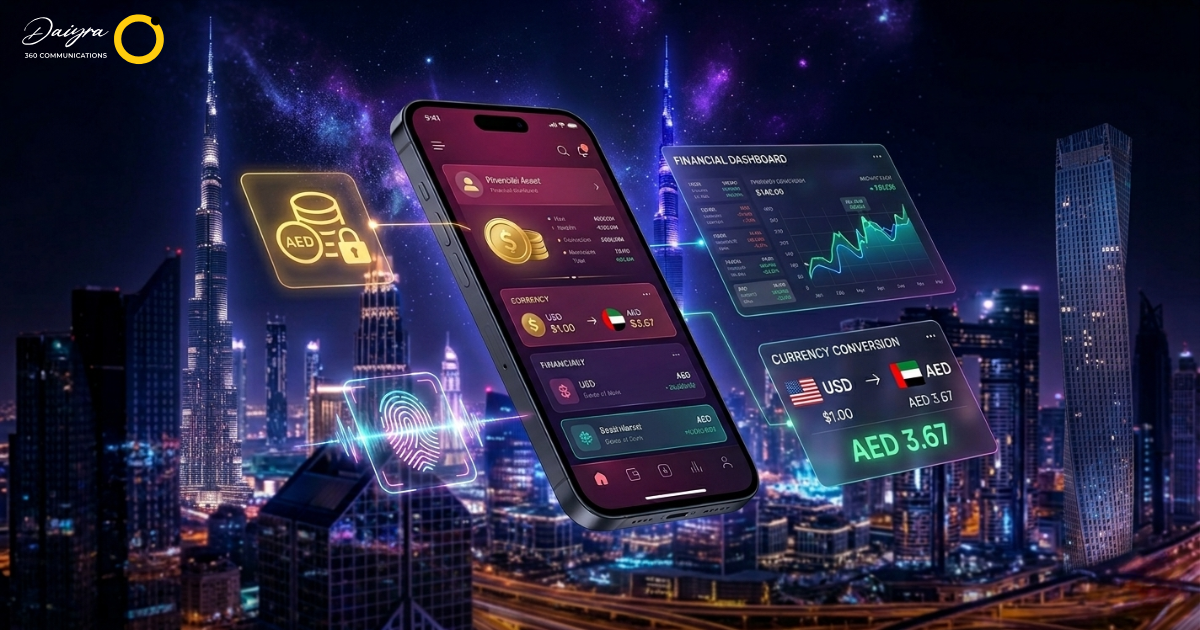
Given the UAE's expat-majority population and volume of cross-border commerce, multi-currency balance management is a product expectation, not a premium feature. AED plus USD, EUR, INR, PHP, and PKR is the minimum viable scope for a consumer-facing fintech product in this market.
Face ID and fingerprint authentication are standard expectations in the UAE market in 2026. Biometric authentication is increasingly referenced in CBUAE guidance on strong customer authentication — building it in from the start is both a product and a compliance decision.
Instant push notifications and a searchable transaction history with category tagging and export capability. UAE users benchmark against Revolut and Wise — the standard is high.
Full RTL layout, Gulf Arabic language support, and Arabic number formatting where applicable. Arabic interface design, Arabic copywriting, and RTL layout engineering are discrete deliverables that must be scoped and budgeted separately from your English product.
Automated screening against sanctions lists, velocity-based transaction flagging, and suspicious activity reporting pipelines. These are regulatory requirements with zero tolerance for post-launch retrofitting.
Categorised spending breakdowns, budget-setting tools, and personalised financial summaries. This is the most consistently cited feature in positive UAE fintech app reviews — and the most commonly missing from first-generation builds.
For fintech apps handling high support query volumes, an AI chatbot layer handling tier-one queries in both Arabic and English — integrated with WhatsApp Business API — is now a competitive expectation. Platforms that deploy this consistently reduce tier-one support costs by 40 to 60 percent within the first six months of production.
04 Tech Stack Choices That Carry Regulatory Weight
In fintech, technology decisions carry regulatory weight, not just engineering implications. Your stack determines your data residency options, your third-party integration surface area, and your ability to pass the security assessments required by CBUAE and DFSA before a licence is granted.
Mobile Platform: Native vs Cross-Platform
Flutter and React Native have both matured to the point where their security APIs are production-grade for fintech in 2026. Native Swift and Kotlin development remains the lower-risk choice for products requiring deep hardware integration — NFC payment functionality or in-app card issuance.
| Factor | Flutter / React Native | Native (Swift / Kotlin) | Verdict |
| Build Cost | Single codebase — 30–50% lower | Dual build doubles dev cost | Cross-Platform |
| Biometric Auth | Production-grade via platform APIs | Full native integration | Even |
| NFC / Card Issuance | Limited — platform restrictions apply | Full hardware access | Native |
| Security Assessment | Passes CBUAE assessment in 2026 | Lower risk for complex builds | Native (complex) |
| Update Speed | Single deploy — both platforms | Two app store submissions per update | Cross-Platform |
Backend and Data Residency
The UAE's data protection framework requires that personally identifiable financial data be stored within the UAE or in approved jurisdictions. AWS Middle East (UAE) region, Microsoft Azure UAE North, and Google Cloud's UAE infrastructure are all viable options. Confirm your data residency architecture with your legal team before committing to a cloud provider.
Payment Rail Integrations
The UAE's payment infrastructure in 2026 includes the Central Bank's Instant Payment Platform (IPP) for domestic transfers, SWIFT for international transfers, and a growing ecosystem of open banking APIs from major UAE banks. Your integration choices affect both feature capability and regulatory scope.
05 The Development Process: What Each Phase Involves
A fintech app development project in Dubai follows a more structured phase sequence than a standard consumer app build — primarily because regulatory milestones must be met before certain development phases can proceed.
Map your product's features against the applicable regulatory framework. Determine licence category, data residency requirements, and mandatory technical controls. Engage a UAE-qualified fintech legal advisor alongside your development partner — this is not a step that can be skipped.
Define your MVP feature set, technical architecture, third-party integration dependencies, and data model. Architecture review by a security specialist before development begins will save significant cost compared to identifying vulnerabilities during QA or the CBUAE security assessment.
High-fidelity design across all user flows — onboarding, KYC, transaction, support, and account settings. Arabic and English versions must be designed in parallel, not translated post-facto. User testing with a UAE-representative sample group during this phase catches usability issues early.
Sprint-based build with weekly review milestones. Backend, mobile, and integration tracks run in parallel where architecture permits. AML/KYC integrations and payment rail connections are typically the longest lead-time items — buffer time for integration issues is realistic planning, not optional.
CBUAE requires a formal security assessment for payment service providers prior to licence grant. Budget this separately from development costs. Engaging the security assessor during architecture design reduces remediation costs significantly.
Apple App Store and Google Play both apply additional scrutiny to fintech applications. Prepare regulatory documentation, privacy policy, and data handling disclosures as part of submission preparation. Both platforms frequently request supplementary documentation for financial services apps.
06 2026 Cost Breakdown: UAE Market Rates
The figures below reflect production-grade UAE market rates for 2026 — deployed products that handle real users, real transactions, and ongoing regulatory obligations. These are not prototype estimates.
| Scope / Component | Complexity | Est. Cost (AED) | Notes |
| Digital KYC & Onboarding | Medium | 30,000 – 60,000 | Emirates ID scan, liveness check, document verification |
| Core Wallet & Transaction Engine | High | 70,000 – 130,000 | Multi-currency balance, real-time feeds, transfer flows |
| AML / Transaction Monitoring | Critical | 25,000 – 55,000 | Sanctions screening, velocity rules, SAR reporting |
| Payment Rail Integrations | High | 40,000 – 90,000 | UAE IPP, SWIFT, open banking APIs |
| UI/UX Design (Arabic + English) | Medium | 25,000 – 50,000 | Both languages designed natively — RTL scoped separately |
| Security Assessment & Pentest | Critical | 20,000 – 45,000 | Required for CBUAE licence — separate line item |
| AI Support Layer (Arabic + English) | Medium | 15,000 – 35,000 | Chatbot, escalation logic, WhatsApp Business API |
| Spending Insights & Analytics | Medium | 18,000 – 40,000 | Category engine, dashboard, export |
| Full Production Fintech MVP | High | 180,000 – 550,000+ | Scope, platform, and integration count drive the variance |
Ongoing costs after launch — cloud infrastructure, third-party API fees, security monitoring, support tooling, and app maintenance — typically run AED 8,000 to 22,000 per month. Build these into your financial model before you raise or commit capital to a launch timeline.
07 Mistakes Dubai Founders Make Before They Build
These are the decisions that consistently cost founders time and money when made incorrectly at the start of a fintech project in the UAE.
A beautiful product built on the wrong licensing assumption requires either a feature pivot or a full rearchitecture — both of which are expensive after the design phase is complete.
Arabic interface design, Arabic copywriting, Gulf dialect NLP support, and RTL layout engineering are discrete deliverables. Scope them separately and test with native Arabic-speaking UAE users.
The remediation cycle following a CBUAE security assessment can add 6 to 12 weeks to your launch timeline if not anticipated. Engage the security assessor early in the project, not at the end of development.
Payment rail integrations, AML architecture, and CBUAE-specific compliance requirements are learned through shipping UAE fintech products. Ask to speak with engineers who have built and deployed UAE-compliant fintech products.
If your development partner cannot name the specific UAE payment rails they have integrated in production, the specific CBUAE security assessment process they have navigated, and the specific Arabic NLP approach they use — they are learning on your project budget.
Ready to Build Your Fintech App in Dubai?
Whether you have a validated product concept or are still mapping your licensing position — the right starting point is a clear, honest assessment of where to begin.
Request a Free Strategy Session →Or call us directly: +971 58 170 0765
08 Frequently Asked Questions
Final Verdict
The UAE fintech opportunity is real, the timing is competitive, and the regulatory frameworks are increasingly accessible for well-capitalised, compliance-first entrants. The market attracted over USD 800 million in investment in 2025. Consumer adoption of digital-first financial products in the Emirates now rivals markets like Singapore and the UK.
The difference between fintech projects that reach launch and those that stall in compliance remediation is almost always the same: founders who mapped their regulatory position before their architecture are in the first group. Founders who treated compliance as something to figure out later are in the second.
Build for your product requirements. Sequence your technology and compliance investment to match your stage. And if you are not sure which path fits your specific product — that is exactly the conversation we have every week with Dubai founders. Book a free call with the Daiyra 360 team.