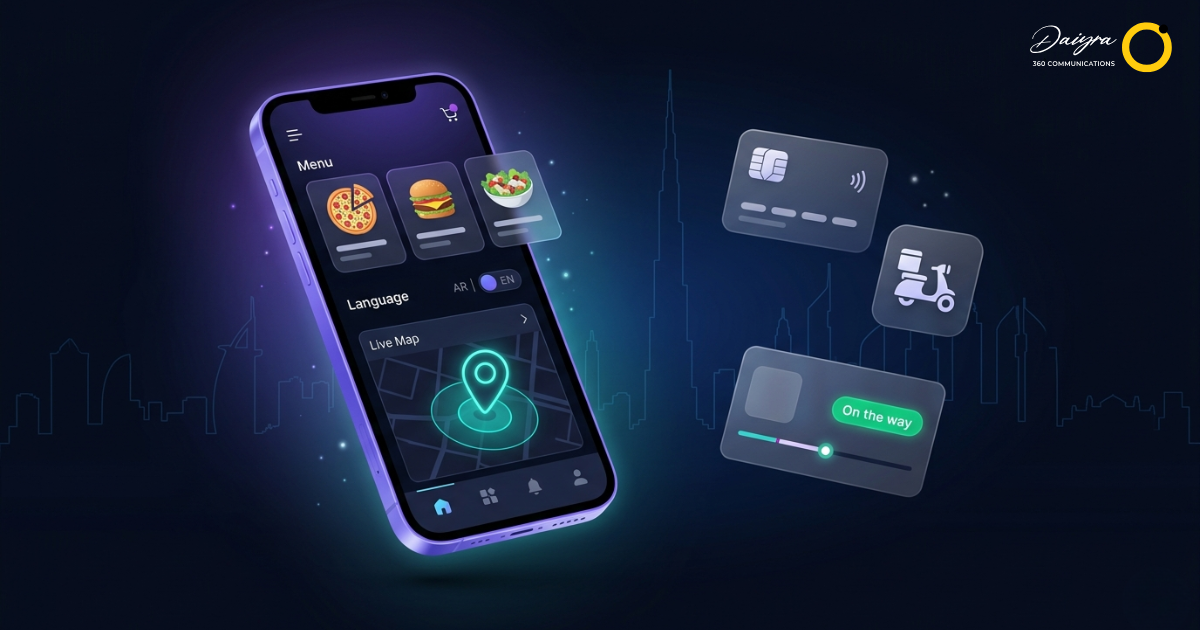
Quick Answer: What Does App Development Cost in Dubai in 2026?
In Dubai, mobile app development typically costs between AED 15,000 and AED 500,000+. A basic MVP starts from AED 15,000–40,000. A standard business app (iOS + Android) runs AED 40,000–120,000. Complex platforms — e-commerce, on-demand, fintech — range from AED 120,000 to AED 500,000+.
This guide gives you real numbers, explains what drives costs up or down, and walks through every factor a UAE business needs to understand before starting development.
Why App Development in Dubai Costs More Than Global Averages
Most online guides use Western or South Asian pricing. Dubai sits in its own tier — below the US and UK, above India and Eastern Europe — with a unique set of requirements that add cost at every stage.
Developers and agencies in Dubai price their work to reflect:
- Higher operating costs — office rent, visa sponsorship, UAE employment overheads
- UAE-market expertise — Arabic RTL design, local compliance, payment gateway knowledge
- Quality standards — Dubai users and clients expect polished, premium digital products
- Talent cost — senior mobile developers in Dubai earn AED 25,000–45,000/month in-house
For businesses building specifically for the UAE or GCC market, this premium typically pays for itself. An offshore team unfamiliar with UAE payment gateways, Arabic layout logic, or PDPL compliance will cost more to correct than it saved upfront.
Full App Development Cost Breakdown for Dubai (2026)
By App Complexity
By App Category
Different app types carry very different engineering demands. Two apps that look similar on the surface can have dramatically different backend complexity and regulatory overhead:
Where Your Budget Actually Goes: Phase-by-Phase Breakdown
Understanding how budget is distributed across development phases helps you make smarter trade-offs — and know where investing more returns real value versus where to save.
Discovery and scoping is the most underfunded phase. Investing AED 10,000–20,000 upfront in proper scoping saves multiples of that in rework, scope creep, and misaligned development later.
7 Key Factors That Determine Your Final App Cost
1. Platform Choice: iOS, Android, or Both
Building for a single platform is cheaper than building for two. Cross-platform frameworks — particularly Flutter — allow a single codebase to run on both iOS and Android, reducing development time and cost by 30–40% compared to separate native builds. For most UAE business apps, Flutter offers the right balance of performance, cost, and bilingual support.
More on Mobile App Development approaches at Daiyra — including when native vs cross-platform is the right choice for your specific project.
2. Design Quality and Bilingual Requirements
Standard UI components are inexpensive. Custom animations, bespoke layouts, and premium interaction design are not. In Dubai's market, design quality is not optional — users expect polished experiences, and a generic-looking app in a competitive category damages your brand.
Arabic RTL support adds 15–25% to design and QA time. Arabic is not translated English — the entire UI layout direction, button placement, typography system, and input logic needs to be rebuilt and validated independently.
Daiyra's UI/UX Research & Design process starts with user research before wireframes — ensuring design decisions are grounded in how UAE users actually behave.
3. Backend Complexity
Static-content apps need minimal backend infrastructure. Apps with user authentication, real-time data, notifications, payments, or admin dashboards require a fully architected backend — with UAE-specific requirements for data hosting, security architecture, and PDPL compliance.
4. UAE-Specific Technical Requirements
5. Third-Party Integrations
Each external service adds development, testing, and maintenance cost. A rough benchmark: each major integration adds AED 3,000–15,000 depending on API complexity. Common UAE-market integrations include Telr, PayTabs, Google Maps, WhatsApp Business API, Firebase, and UAE PASS.
6. Developer Type and Location
7. Post-Launch and Ongoing Costs
Real Cost Example: Home Services Booking App in Dubai
If a quote for this type of app is significantly below AED 40,000, ask specifically what is excluded. Scope gaps are where hidden costs appear after launch.
MVP vs Full Product: Which Should You Build First?
The most successful apps started as lean MVPs and scaled based on real user behaviour. Building a fully-loaded product before validating demand is one of the fastest ways to waste your development budget.
5 Ways to Reduce App Development Costs Without Cutting Quality
1. Define scope before approaching developers
Document your user flows, core features, and what you explicitly will NOT build in version one. A tight scope reduces quote variance, prevents scope creep, and protects your budget.
2. Use Flutter or React Native
Cross-platform development cuts native build costs by 30–40% with minimal performance compromise for most business app use cases.
3. Use existing infrastructure
Payment gateways, auth providers, map SDKs, analytics tools — these are pre-built. Custom-built equivalents look impressive but add months of development and maintenance cost.
4. Prioritise ruthlessly
For each proposed feature, ask: does this need to be in version one? A focused app built well outperforms a feature-heavy app built fast, consistently.
5. Budget for maintenance upfront
Apps that aren't maintained fail. Include Year 1 maintenance in your original budget — not as an afterthought after launch.
Questions to Ask Before Hiring a Dubai App Developer
- Do you have examples of Arabic/bilingual apps you have built? A developer who has never built RTL will learn on your budget.
- What happens if the project exceeds scope? Get this in writing, not in conversation.
- Do you use Flutter, React Native, or native — and why for my project? There is no universally correct answer. Understand the reasoning.
- What does post-launch support include, and at what cost? Scope this before signing, not after launch.
- Who owns the source code at project end? You should own it fully. Some agencies retain code as leverage.
- Can you provide a fixed-price quote based on a documented scope? Reputable developers scope before quoting.
- Have you integrated UAE payment gateways before? Telr and PayTabs have non-trivial requirements. Experience matters.
Dubai's Mobile App Market in 2026: Context for Your Investment
- UAE smartphone penetration exceeds 97% — among the highest globally
- The UAE mobile app market is projected to reach USD 2.3 billion by 2030, growing at 10.3% CAGR
- Dubai's D33 Economic Agenda actively prioritises and funds digital transformation
- UAE users have strong spending power and above-average digital intent — if an experience is good, they pay for it
- Government programmes like UAE PASS create integration opportunities unique to this market
- Low corporate tax (9%) reduces the effective cost of digital investment
For businesses targeting UAE consumers or B2B enterprise clients in the region, a well-built mobile app is not just a marketing asset — it is operational infrastructure.
Frequently Asked Questions
A simple app — single platform, basic design, no complex backend — costs AED 15,000–40,000. For a public-facing product on both iOS and Android, budget AED 40,000–80,000 minimum.
Basic apps: 4–8 weeks. Standard business apps: 2–5 months. Complex platforms: 6–12 months. Timeline is driven primarily by scope complexity, design iterations, integration testing, and App Store review periods.
Offshore development is cheaper per hour — South Asian freelancers charge AED 50–120/hour vs AED 200–450/hour for Dubai agencies. However, for UAE-market apps, Dubai-based development often costs less in total because offshore teams typically require substantial rework for Arabic RTL, UAE payment integration, and local compliance.
Build a cross-platform MVP using Flutter, targeting one platform first, with minimal custom design and no complex backend. A focused MVP can be built for AED 15,000–30,000. No-code tools can go lower but scale poorly and have significant customisation limits.
It depends on your target audience. Apps targeting UAE nationals, government entities, or general consumers benefit significantly from Arabic RTL support. Apps serving expat-heavy professional verticals can often launch English-first. Arabic support meaningfully expands your addressable market and is often required for government-related applications.
Primary UAE-compatible payment gateways: Telr, PayTabs, Network International (NI). Apple Pay and Google Pay are widely used in the UAE with minimal integration overhead. Stripe works for USD-denominated transactions. Crypto payments are available through licensed UAE providers for specific use cases.
Annual maintenance typically costs 15–20% of the original build cost. For a AED 100,000 app, expect AED 15,000–20,000/year for bug fixes, OS updates, security patches, and minor feature work. Major new features are priced separately.