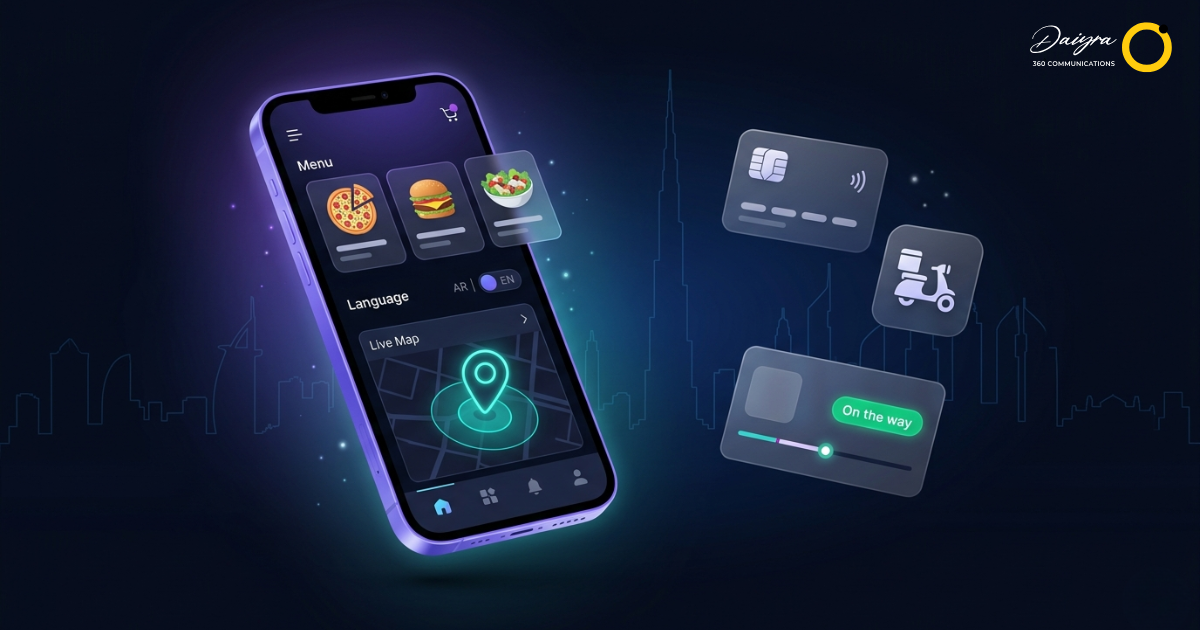
Dubai never stops eating. With 97% smartphone penetration, a population of over 3.5 million, and a culture built around speed and convenience, the UAE's online food delivery market is projected to reach USD 3.86 billion by 2030 — growing at 10.2% annually.
Talabat, Deliveroo, Careem NOW, and newcomer Keeta have proven the demand is real. But they serve the masses. The fastest-growing opportunity belongs to branded restaurant apps, cloud kitchen platforms, and niche delivery services that serve specific communities better than any aggregator can.
This guide gives you everything you need before starting development: the business models that work in Dubai, the features your app must have, real AED costs, the right tech stack for the UAE market, and a timeline grounded in actual project experience.
Why Dubai Still Has Room for New Food Delivery Apps
The aggregator market is consolidated — but not saturated in the right segments.
Dubai market share breakdown (2026):
The gaps these platforms leave open:
- Halal-certified meal delivery with full ingredient transparency
- Home-cooked meal platforms for specific diaspora communities
- Ramadan-focused services with iftar and suhoor scheduling
- Premium corporate catering with account management
- Cloud kitchen branded apps that cut the 15–30% aggregator commission
THE CLOUD KITCHEN MATHS — At 500 monthly orders averaging AED 80 each, a cloud kitchen pays AED 6,000–12,000/month in aggregator commissions. A branded app typically pays for itself within 12–18 months at this volume.
Step 1: Choose Your Business Model First
Your model determines every technical and design decision that follows. There are three approaches that work in Dubai.
Most businesses approaching us at Daiyra 360 start with the Restaurant-Specific or Cloud Kitchen model — shorter build, lower capital requirement, faster break-even, and a clear path to ROI before scaling.
Step 2: Features — The Four Panels Every Food Delivery App Needs
A food delivery app is not one app. It is four connected panels working in real time. Underinvesting in any one panel causes operational failures that compound at scale.
Panel 1: Customer App (iOS + Android)
This is where first impressions are made and where churn happens.
ON ARABIC RTL — This cannot be retrofitted after the English build. Every screen must be designed bilingually from the start. Adding Arabic after launch adds 40–60% more cost versus building bilingually from day one. This is one of the primary reasons we recommend Flutter for Dubai food delivery apps — it handles RTL automatically at the framework level. See our full breakdown in Flutter vs React Native: Which Is Better for Dubai Businesses in 2026.
Panel 2: Restaurant Dashboard (Web + Mobile)
The most underinvested panel — and the one that causes platforms to fail with early restaurant partners.
- Real-time menu management — add items, update prices, toggle dishes off when sold out
- Time-based menus — breakfast, lunch, weekend specials scheduled automatically
- Order management with audible alerts — incoming orders visible immediately with accept/reject
- Production timer — shows kitchen how long each order has been waiting
- Sales analytics — daily revenue, popular items, peak order times, average order value
- Direct notification when orders are ready for pickup
A restaurant manager who can't control their menu in real time will call your operations team constantly — or leave your platform.
Panel 3: Driver App
Driver experience determines your delivery speed and consistency — the two metrics customers judge you on.
- Live order assignment with optimal routing via Google Maps
- Real-time earnings per shift and weekly summary
- Delivery instructions with building access codes and floor numbers (critical for Dubai's gated communities and tower complexes)
- In-app customer communication for address clarification
- Order history and performance metrics
- Document management (Emirates ID, driving licence, vehicle registration)
Panel 4: Admin Panel
Your operational command centre. A well-built admin panel lets a small team manage a large platform.
- Restaurant onboarding and approval workflow
- Driver zone management and fleet overview
- Live order monitoring across all active deliveries
- Dispute resolution with order history access
- Promotional campaign management (discount codes, free delivery windows)
- Financial reporting — revenue, commissions, payouts, refunds
Advanced Features That Matter in Dubai
Beyond the core system, these features have become competitive requirements in the Dubai market:
Step 3: Real Costs in AED — What Food Delivery Apps Actually Cost in Dubai
Most online estimates are in USD, exclude the restaurant and driver panels, and aren't priced for the UAE market. Here are realistic AED ranges for full four-panel systems built to Dubai market standards.
Cost by Build Level
These figures align with our full breakdown in How Much Does App Development Cost in Dubai? (2026 Guide) — where on-demand service apps sit at AED 150,000–350,000 for standard builds.
Where Your Budget Goes (Phase Breakdown)
Ongoing Monthly Costs to Budget For
Step 4: The Right Tech Stack for Dubai Food Delivery Apps
Technology decisions made at the start are expensive to reverse. Here is what works best for the UAE market in 2026.
ON FLUTTER VS REACT NATIVE FOR THIS USE CASE — Flutter's automatic RTL support, consistent rendering across UAE's diverse device range (from iPhone 16 Pro to mid-range Android), and lower bilingual development cost make it the clear choice for food delivery apps in Dubai. Full comparison in our Flutter vs React Native guide for Dubai businesses.
Step 5: Dubai-Specific Requirements You Can't Ignore
Building for Dubai means requirements that no global app development guide covers.
Step 6: Development Timeline — Idea to Launch
Based on delivery projects for UAE clients including NRTC's farm-to-door delivery platform and Splidu's premium dining experience app, here is what a realistic MVP timeline looks like.
Mid-level platform with loyalty features: add 2–3 months | Aggregator-scale marketplace: 10–14 months total
Build Your Own App vs List on Talabat: The Real Numbers
This is the most common question from Dubai restaurant owners. Here is the honest comparison.
When the Maths Favours Building
At 500 monthly orders averaging AED 80:
- Aggregator commission (20%): AED 8,000/month = AED 96,000/year
- App maintenance cost: ~AED 25,000/year
- Net saving: AED 71,000/year — paying back a AED 150,000 MVP investment in roughly 26 months
The most effective strategy for established Dubai F&B brands: run both. Use aggregators for new customer acquisition (treat commission as a customer acquisition cost) and your branded app for retention, loyalty, and direct margin.
Who Is Building Food Delivery Apps in Dubai Right Now?
The three client profiles currently approaching Daiyra 360 for food delivery development:
Restaurant groups (3–10 locations)
- Paying AED 60,000–120,000/month in aggregator commissions
- Want to shift 30–40% of volume to a branded channel within 18 months
- Need a polished app that matches the quality of their dining experience
Cloud kitchen operators (2–4 virtual brands)
- Sharing one kitchen but listed separately on Talabat
- Want a single branded platform they control
- Prioritise rapid build and low ongoing cost
Niche entrepreneurs
- Organic/clean eating delivery
- Home-cooked meals for specific diaspora communities (South Asian, Levantine, East African)
- Corporate catering with account management and invoicing
In all three cases, the app is not the risk — underinvesting in restaurant onboarding, customer acquisition, and post-launch iteration is the risk. The app is infrastructure. What you build on top of it determines whether it becomes a revenue asset or an expensive experiment.
Our portfolio includes on-demand delivery platforms, F&B apps, and marketplace builds for UAE clients — including NRTC (farm-to-door premium delivery) and Splidu (exclusive dining experiences and chef booking).
Frequently Asked Questions
A full four-panel food delivery app — customer app (iOS + Android), restaurant dashboard, driver app, and admin panel — costs AED 110,000–220,000 for an MVP in Dubai in 2026. A mid-level platform with loyalty and advanced features runs AED 220,000–400,000. Aggregator-scale marketplace platforms cost AED 400,000+.
An MVP covering all four panels takes 6 to 7 months from discovery to launch. A mid-level platform adds 2–3 months. Complex aggregator marketplace platforms take 10–14 months total.
Flutter (mobile), Node.js with microservices (backend), PostgreSQL + Redis (database), Google Maps API + Socket.io (real-time tracking), PayFort or Telr (payments), AWS or Azure UAE region (cloud hosting).
Yes. Any food delivery app targeting the UAE market needs full Arabic RTL support designed from the start — not a post-launch translation. Adding Arabic after the English build is complete adds 40–60% more cost.
PayFort (Amazon Payment Services), Telr, and Network International are the primary UAE-compatible gateways. All support Apple Pay, Google Pay, credit/debit cards, and UAE bank integrations. Apple Pay must be included — UAE adoption is among the highest globally.
At around 500 monthly orders, the saved commissions from a branded app typically outpace the annualised development cost. Most established Dubai F&B brands run both: aggregators for acquisition, branded app for retention and margin improvement.
Arabic RTL support from day one, UAE PDPL compliance, halal filtering, UAE-native payment gateways (PayFort/Telr), AWS/Azure UAE region hosting for data residency, and Ramadan scheduling features are all Dubai-specific requirements that global build guides don't cover.